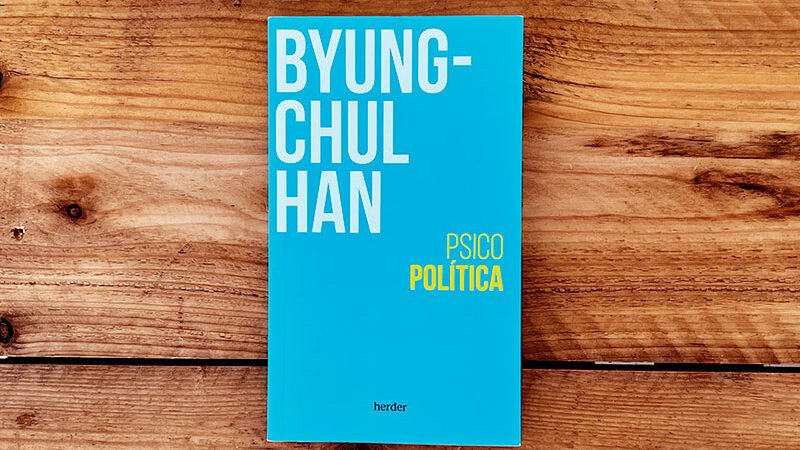
Libro de Byung-Chul Han 2014
There are books you finish and think: that was interesting. And then there are others that make you finish reading and start looking at your phone just a little differently. Psychopolitics, by Byung-Chul Han, was more of the second kind for me.
The book starts from a rather unsettling idea: perhaps the most effective form of power is not the one that forces us to do something, but the one that manages to make us want to do it ourselves. Han analyzes neoliberalism and argues that traditional forms of power have changed. We no longer live solely under a form of power that prohibits, punishes, or watches us from the outside. Contemporary power, according to him, is much more pleasant and seemingly benign. It tells us that we can do whatever we want, that we can become anything, that we should work on ourselves, improve, be productive, and show the best version of ourselves.
And that is precisely where the trap lies. Because if someone once had to force you to work, now you can end up exploiting yourself.
The concept that stayed with me the most from the book is that of the “achievement subject” (Leistungssubjekt). Han argues that we have moved from a society based on “you must” to one based on “you can.” And apparently, that sounds much better. Nobody is forcing you. You decide to study more, work more, exercise, start a business, be productive, improve your appearance, learn another language, have an interesting life…
But the problem appears when that “I can” turns into an “I have to.”
Because then resting starts to feel like laziness. Doing nothing feels like wasting time. And failing to achieve what you wanted to achieve stops feeling like a failure caused by circumstances and starts feeling like a personal failure.
Han takes this idea quite far: he argues that under neoliberalism, each person becomes a kind of entrepreneur of themselves. We are simultaneously our own boss and our own employee.
And this explains something I found particularly interesting: the way Han connects this self-exploitation to conditions such as exhaustion, burnout, and depression. Not because he claims that every case of depression is caused by capitalism—that would be far too simplistic an interpretation—but because he uses these conditions as symptoms of a society in which the demand for performance may have no limit.
And then the book dives straight into something even closer to our everyday lives: the internet and social media.
Han compares our digital society to a new kind of panopticon. But there is a fundamental difference from the classical panopticon: here, nobody needs to force us to show our lives.
Psico-politics
Click to read the book
We show them voluntarily.
We upload photographs, write what we think, tell people where we are, what we buy, what we like, what we want, what we are doing, and even how we feel. Every click, search, and interaction can become information about us. The book argues that Big Data makes it possible to construct increasingly precise profiles of our behavior and use that data to anticipate and influence our actions.
And here we arrive at one of the most interesting ideas in the entire book: surveillance no longer necessarily feels like surveillance.
There is no person standing behind us telling us what to do. We have a phone that offers us content we want to see, apps that reward us with notifications, platforms that tell us what we might be interested in, and a “like” button that seems completely innocent.
Han even calls the like a kind of “digital amen.”
Because we voluntarily participate in the system.
And I think this is the part that is most worth thinking about, because it is very easy to read this and conclude: “Social media is bad and it controls us.” But Han’s argument is considerably more interesting than that.
The issue is not simply that someone is watching us.
The issue is that we collaborate with that surveillance because we also get something out of it.
We want attention. We want recognition. We want to belong. We want to show who we are. We want to be seen.
And this connects the book to another concept that I find extremely important: the capitalism of emotions.
Han argues that emotions have become something that can be economically exploited. What matters is no longer just our ability to work or our knowledge; our emotions, desires, preferences, and whatever manages to capture our attention are also valuable.
And if we think about it, it makes quite a lot of sense.
Platforms do not need you to be forced to sit in front of a screen. They need to make you want to sit in front of it.
They don’t need to tell you, “Stay.”
They need to give you something interesting enough that you decide to stay.
And that completely changes the relationship between power and freedom.
Because one of the central questions of Psychopolitics is precisely this:
What happens when freedom becomes a tool of control?
Han argues that freedom can end up generating its own forms of coercion. The individual feels free because nobody is forcing them to do anything, while at the same time submitting to a constant demand for performance, optimization, and self-improvement.
Now, I also don’t think Psychopolitics is a perfect book.
Sometimes Han makes enormous and rather definitive claims, and I feel that at certain points he takes
his arguments too far. His reading of neoliberalism is highly critical and, precisely because of that, can
feel somewhat one-sided. Moreover, his concepts are philosophical, and the book constantly engages
with authors such as Foucault, Marx, Deleuze, and Nietzsche, so it is definitely not a particularly light
read.
But I think that difficulty also has something good about it.
It is not a book that simply tells you what to think. It is a book that gives you concepts with which to
begin questioning things we normally take for granted.
For example, after reading it, you may start asking yourself:
Why do I feel like I should always be doing something?
Why do I feel guilty when I rest?
Why do I feel the need to show certain parts of my life?
Why do I want other people to know that I am doing something?
To what extent are my tastes really my own?
And how much of what I desire has been learned, suggested, or produced by the environment in which I
live?
I think that is where the true value of Psychopolitics lies.
Not necessarily in accepting everything Han says, but in allowing some of his ideas to stay in the back of
your mind and keep turning over.
Because perhaps the most efficient form of control is not telling us “you can’t.”
Perhaps it is convincing us that “you can do anything,” while silently making us responsible for doing
everything. And that is a rather uncomfortable idea to end a book with.
My rating: 4/5. Not because I agree with absolutely everything Han argues, but because it is one of those books that
can make something as ordinary as a phone, a like, a notification, an app, or even our obsession with
self-improvement suddenly seem a little strange. And to me, that is exactly what a good philosophy book should do: one that manages to make you see the world slightly differently after you close it
Deja un comentario